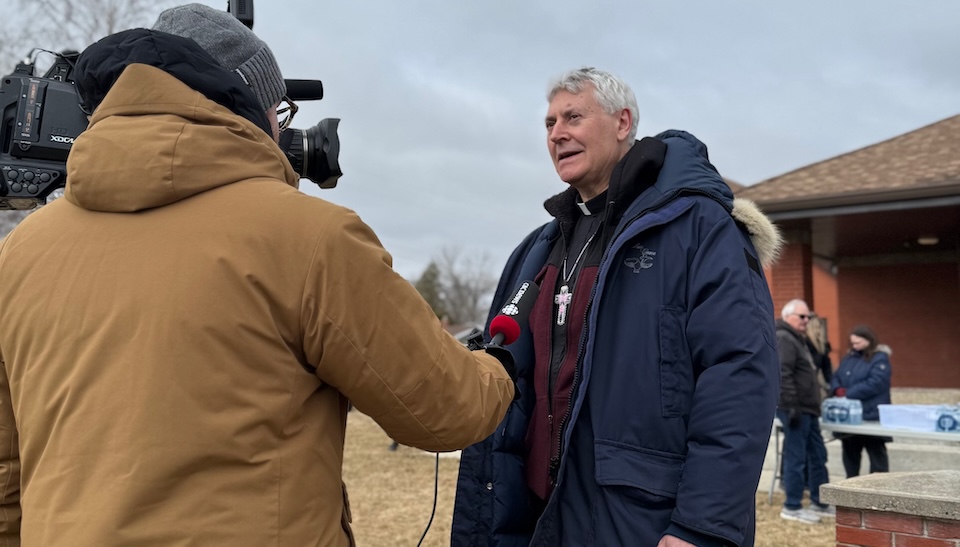
In 2011, the English-speaking world welcomed the new translation of the Roman Missal. One of the key figures responsible for the translation was a Canadian Jesuit: Archbishop Terrence Prendergast. The Montreal native is presently the Archbishop of Ottawa, as well as Canada’s representative on the Vox Clara committee of the Vatican’s Congregation for Divine Worship. He previously served as Auxiliary Bishop of Toronto and Archbishop of Halifax. Witness host Fr. Thomas Rosica spoke with the Archbishop at the 2011 plenary assembly of the Canadian bishops’ conference.
Finding God in all things with Ottawa’s Archbishop
Perspectives Daily – Monday, Jan. 30
Tonight on Perspectives, the pope releases doves for the day of prayer for peace in the Holy Land and Catholic News Service gives us a look at the Second Vatican Council.
Religious: What does that mean?
In recent months I’ve had many conversations about what it means to be a “religious” person. Not in the sense of a religious vocation or the priestly life, but as one of the majority of those who profess the Creed from the pews on Sunday – the laity. These conversations have come from across the spectrum, with close friends and first encounters, with young people like me and older generations, with those who enthusiastically practice their faith and those who claim they have no faith to practice. Interestingly, the majority of these conversations occur with people from the last group. I grant that today this group is a majority in our society, especially among young people, but this is not the real point of interest. What is so fascinating about this particular conversation with this particular group of people is the genuine curiosity emanating from them about religion. They have questions.
Of their own point of view many say that it is important to be in touch with our spiritual nature in some form, however each individual chooses to do so. But there is a great skepticism of institutionalized religion, and in particular of the three monotheisms which significantly influence our world: Christianity, Judaism and Islam. This skepticism is especially strong of Catholicism, in part because of the way it’s portrayed in the secular media which seeks to subvert the Church’s influence and tends to thrive on controversy. For this reason, the skeptical point of view is often superficial and seldom based on a critical analysis of the Creed or the history of our tradition. We cannot underestimate the influence of forces at work in our societies which misconstrue the real nature of the Church.
The truth is that many of these people that I’ve had the opportunity to discuss the question of religiosity with have a very limited understanding of Catholicism and the other great traditions which have shaped human history. And in the absence of such knowledge, many have adopted a position of spiritual relativism or scientific materialism. But their genuine curiosity of religious questions seems to suggest a sense of dissatisfaction, perhaps with their own philosophy, and certainly with their current level of understanding. So when the opportunity comes to share my thoughts about what it means to be a “religious” person, I tend to challenge the many misconceptions. And I find that the most meaningful conversations come, not when we discuss fine points of theology, but rather the characteristics of a religious person today. The perception is that such a person is detached from society: primitive in their understanding of modern culture, traditional in their social values, unprogressive, morally stringent, and condemning of other creeds. Evidently it is baffling that someone who goes to church on Sunday might also have been to a hockey game on Saturday or a bar on Friday.
This is the kind of superficial perception that must change if the deeper theological questions are to be discussed meaningfully. In this sense, the average person who professes no particular faith must be able to relate to the average person who does. Then, once this connection is made, the conversation can open to any topic including the question of religion and religiosity – the thing everyone seems to want to talk about.
-
Credit: CNS Photo
A light hearted Angelus
This Sunday was the World day of Prayer for those suffering from Leprosy, a new blessed was recognized in a ceremony in Vienna, and it was the Day of Prayer for Peace in the Holy Land. It has become customary for the pope to have two children from Italy’s Catholic Action group join him at his window on this day and release two doves after the Angelus address. This year the doves had a mind of their own.
Perspectives Weekly – International Eucharistic Congress 2012
On the January 27 edition of Perspectives: The Weekly Edition, Pedro plays devil’s advocate and asks Fr. Kevin Doran, Secretary General of the 2012 International Eucharistic Congress, why we should go to Ireland to attend. Some people think it’s a World Youth Day for adults, but is that accurate? Tune in to find out why this exceptional gathering of the Universal Church will set your heart ablaze with love.
Where Christian unity isn’t so ordinary
It’s easy to take ecumenism for granted in Canada, even during this Week of Prayer for Christian Unity. Of course, the full expression of visible unity has not been achieved, and won’t likely occur within our lifetime. But we have grown so accustomed to respectful relations and cooperative efforts on social issues that our prayers for unity often lack a sense of urgency.
In other parts of the world, ecumenism must overcome rifts that have deepened over centuries. Such is the case in the Holy Land, where multiple denominations share custody of holy sites. On December 28, a dispute between Greek Orthodox and Armenian Orthodox monks at the Church of the Nativity escalated into a brawl with broomsticks.
Fortunately, this isn’t the whole story. Since 2009, Christians in Jerusalem have been participating in prayer gatherings called the Extraordinary Prayer of all Churches for Reconciliation, Unity and Peace. The liturgies are endorsed by the Catholic Church, among other denominations. This Saturday, the Coptic Orthodox Church of St. Anthony will host the seventh such event. S+L will air the Extraordinary Prayer live in French this Saturday morning starting at 11:00am ET / 8:00am PT. The Franciscan Media Centre previews the event in the above video.
Are you going to go my Way?
They said to each other,”Did not our hearts burn within us while he talked to us on the road, while he opened to us the Scriptures?” (Lk 24:32)
Ever considered attending an International Eucharistic Congress? You should. As we journey through life, not unlike the disciples on the road to Emmaus we find ourselves disoriented, distracted and eventually unable to sense Christ’s presence in our lives. But Christ draws near to us in the celebration of the Eucharist. So what better way to be nourished than to celebrate the healing power of the Eucharist. Dublin, Ireland will host the 50th International Eucharistic Congress, June 10 –17th 2012. This is the second time Ireland will host the universal church, the last being in 1932. Some of you may recall that the last International Eucharistic Congress was held in Quebec City in 2008.
This week on Perspectives: The Weekly Edition, Pedro plays devil’s advocate and asks Fr. Kevin Doran, Secretary General of the IEC 2012, “why should we go to the Eucharistic Congress?” Some people think it’s a World Youth Day for adults, but is that accurate? After all, World Youth Day is a relatively new phenomenon compared to the Eucharistic Congress, which dates back to 1881. So tune in to find out why this exceptional gathering will set your heart ablaze with love.
Join us tonight for this discussion on Perspectives Weekly at 7 and 11pm ET / 8pm PT. In the meantime, take part in the discussion on Facebook.
Perspectives Daily – Thursday, Jan. 26
Tonight on Perspectives: The Vatican releases a message ahead of this year’s World Mission Sunday and the Canadian Ukrainian Church has much to celebrate. More than that, one parish in Indiana is planning a “spiritual Superbowl party.” We tell you more.
Good choices at the Oscars
I was pleased on Tuesday morning to see the movie “The Tree of Life” nominated for an Oscar. It was probably one of the most beautiful movies I have ever watched.
The beginning of the movie is a citation from the book of Job: “Where were you when I founded the earth…while the morning stars sang in chorus and all the sons of God shouted for joy?” (Job 38: 4,7) That quote prepares you for what the movie will try to say to you. As Job believed in God’s plan, we too must trust even if each day seems to be a dark night.
The “Tree of Life” is story of a family in the 1950’s. The film follows the story of the eldest brother Jack (Sean Penn) from his childhood into adulthood. The movie is essentially about the way he tries to reconcile a complicated relationship with his father, played by Brad Pitt.
The central idea of the movie is that there are always two forces in opposition: nature and grace, and we have to choose one. We see that life is full of choices between nature and grace and we see nature as something strong, conflicting and violent and grace as something pure, loving and peaceful. However, if we see both as something that comes from God, we understand that he is present in every moment of our lives.
Fr. Robert Baron, in his review of the movie, said, “The way to life, therefore, is a path of surrender and acceptance. I think that ‘Tree of Life’ is communicating this same difficult but vital lesson.”
I would have to agree with him because what I felt was that just as Job accepted all the things God put on his path, we have to look at our lives like that. Sometimes we have to surrender and accept the plan God has for us.
The Vatican’s official newspaper, L’Osservatore Romano, referred to this movie as a “film-prayer addressed to a God”. I see this movie as good for all those who believe in God as the one who is present in every step of our lives.
Nature and grace both come from God, which means we are free to choose our way, and it doesn’t matter which choice we make, He will always be there.
Around the world with a Rosary

Fr. James Phalan, CSC is the director of Family Rosary International, one of the many ministries of the Holy Cross order. His ministry takes him around the world visiting Catholic communities of all shapes, sizes, and demographics. This past week he was in the Philippines and wrote this piece for the Family Rosary blog “World at Prayer.”
“The Filipinos’ faith has been tested by many crosses and trials in a way that seems to strengthen them and their devotion to Mary such that even their overseas workers are first rate evangelizers! They know the cross of hope!” (Fr. Roque D’Costa CSC)
In the last century more than twice as many natural disasters occurred in the Philippines than anywhere else in the world! With typhoons, earthquakes, volcanic eruptions and floods, catastrophes accumulate yearly in the archipelago of 7,000 islands. After the eruption of Mount Pinatubo, masked homeless people tried to keep the fine lahar dust from contaminating their lungs. One Church looked rather normal at first but was literally half full of the volcanic dust, which had hardened into what looked like a new cement floor. The Filipinos had dug down and raised up the altar with its reredos and provided new pews. The window in the choir loft was converted to a door and the Filipinos continued to pray as always, except now they were in the upper half of the original Church. What faith, strengthened by the cross! What resilience!
Holy Cross men and women had survived imprisonment all during World War II there, relying on their prayer life to see them through the crisis. This was a people in love with Our Lady. It seemed that with every new calamity, the Filipinos renewed their confidence in “Mama Mary” and their complete dependence upon God. They came to love the “Rosary priest,” Father Patrick Peyton, and encouraged him to hold Rosary rallies for families attended by millions and to deepen their faith and devotion through media. Today Family Rosary Crusade units are common in Filipino parishes. Essentially Rosary prayer groups, they also reach out in service to the needy, motivated by their prayer and encouraged by Family Rosary television programs.
Holy Cross men and women are in Manila for training at pastoral institutes, and to earn higher degrees at its excellent Catholic universities. The first religious house for Holy Cross members was recently established in the hopes of consolidating the Holy Cross charism throughout the country. A Marian prayerful devotion that leads to action on behalf of justice is at its core. “The cross, our only hope” is a theme lived out prayerfully in the Philippines.
Photo courtesy CNS/Reuters